ChatPDF contract review: same tool, different document type
This is part 2 of my ChatPDF citation series. In part 1, my ChatPDF accuracy review on a research paper, I uploaded a 15-page paper, asked four factual questions, and scored the answers against ground truth. Result there was 3.5 out of 4, with one instructive miss on a hyperparameter.
This time I wanted a different document type. Contracts are the other place where people actually paste PDFs into AI chatters and hope for the truth. So I made my own 1-page freelance agreement, planted specific numbers in it, uploaded it to ChatPDF, and checked every cited answer against the source text.
The headline result is a clean sheet. 4 out of 4 exact, citations on every answer, zero hallucinations. I’m not surprised short explicit documents score well, but I still think the details are worth your time, because the gap between this test and a real 50 page vendor agreement is exactly where trust breaks.
I’m not a lawyer and this isn’t legal advice. It’s an extraction accuracy check. I tested whether ChatPDF reads back what the contract says, not whether the contract is any good.
Quick verdict
Score: 4/4. All four answers exact against planted ground truth, and every answer carried citations to the source passage. No hallucinations on a document that never existed on the public web, which is the strongest form of this check. Tested on the free tier with no account and no login. Best for pulling explicit figures out of short agreements fast, with citations you click before you trust. Not proven on long contracts, scanned pages, or anything you would sign without reading.
Three things to remember from this test:
- 4 out of 4 exact with citations on all four answers. Fee split, late fee, termination and confidentiality, governing law and end date, all correct.
- Zero hallucinations on an unseen custom doc. I generated this agreement myself, so ChatPDF could not have memorized it. Everything it said traced back to the uploaded text.
- Short contracts look easier than papers. Part 1 lost half a point where a paper scattered one value across ablations. A 1-page agreement states each figure once, and ChatPDF nailed all of them. The open question is 50 page contracts, and that is my next test idea.
Prices and limits cited as checked October 2026. Confirm current numbers on chatpdf.com.
Method: what I tested and how you can replicate it
Transparency first, same as part 1. A review without a replicable method is marketing.
- Account used: none. Free tier, no login, no signup. ChatPDF’s free tier allows 2 documents per day, and this single-contract test fits inside it.
- The document is a self-made 1-page freelance agreement, 6 clauses, generated by me with fpdf2. File name is
sample-freelance-agreement.pdf. Because I wrote it, ground truth is fully controlled, so memorization is impossible. - I uploaded the PDF via a temporary file URL. No account needed. The test chat link is retained in my notes.
- Ground truth was fully planted and known before I asked anything. Total fee, split, late fee rate, grace period, notice period, confidentiality term, governing law, end date. I checked each answer character by character against the source.
- I asked four factual questions covering money, penalties, exit terms, and jurisdiction. Each answer has a single correct value stated explicitly in the text.
- Scoring is simple. An exact match gets 1 point. Total: 4/4.
- To reproduce: make any 1-page agreement with planted numbers (fee, rate, dates, law), upload it on the free tier, and re-ask the same four questions. Our test used a self-generated freelance agreement — same method works on your own contracts.
I picked money questions first on purpose. If you freelance, the fee split and the late fee are the two numbers you check before you sign, so those are the two numbers I checked first. Readers who live in contracts will recognize the priorities. Our best AI for freelancers guide covers the wider toolkit around this.
Test transcript (verbatim, reformatted for readability)
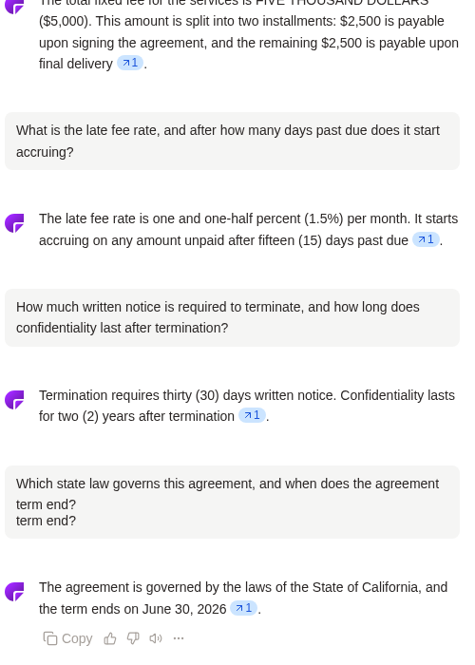
Screenshots from the live test session (free tier, no account). All four answers exact with citations.
Results table: all four questions, faithfully reproduced
| # | Question | ChatPDF answer, with citations | Verdict |
|---|---|---|---|
| 1 | Total fee and payment split? | $5,000 total, $2,500 on signing plus $2,500 on delivery | Exact |
| 2 | Late fee rate and grace period? | 1.5 percent per month after 15 days | Exact |
| 3 | Termination notice and confidentiality term? | 30 days notice, confidentiality runs 2 years | Exact |
| 4 | Governing law and term end date? | California law, term ends June 30, 2026 | Exact |
Score: 4/4. All answers carried citations to PDF passages. Free tier, no login. No hallucinations.
ChatPDF contract review: question by question deep dive
The table gives you the score. This section gives you what each answer tells us about how ChatPDF handles contract text.
Q1: total fee and split, $5,000 with $2,500 plus $2,500
I asked for the total fee and how it splits across milestones. ChatPDF answered $5,000 total, $2,500 on signing and $2,500 on delivery, with a citation to the payment clause. Exact against ground truth.
This is the money question, literally. On a freelance agreement the fee clause is the sentence everything else orbits, and ChatPDF pulled both the headline number and the split in one answer without dropping either half. I’ve seen chatters return the total and skip the split, which forces a follow-up. No follow-up needed here.
Q2: late fee rate and grace, 1.5 percent per month after 15 days
I asked for the late payment terms. ChatPDF answered 1.5 percent per month after a 15 day grace period, cited to the late fee clause. Exact.
I like this answer more than Q1, because it combines two values from one clause correctly. The rate and the grace period are different facts that live in the same sentence, and both came back right with no merging or rounding. If you’ve ever chased an overdue invoice, you know the grace period is the half people misremember. ChatPDF did not.
Q3: termination notice and confidentiality, 30 days and 2 years
I asked for the exit terms. ChatPDF answered 30 days termination notice with confidentiality surviving 2 years, cited. Exact.
This one pairs values from different clauses, notice from the termination section and duration from the confidentiality section, and both landed. That matters because it shows the tool is not just reading one passage per answer. It reached across the document and got each clause right. For a 1-page agreement that is easy work, but it’s exactly the kind of cross-clause lookup freelancers actually need. Termination plus confidentiality is the pairing I would check on any real contract too.
Q4: governing law and end date, California and June 30, 2026
I asked for jurisdiction and term. ChatPDF answered California governing law with the term ending June 30, 2026, cited. Exact.
Two different fact types in one answer, a state name and a calendar date, and both correct. Dates are where I watch chatters most closely, since off by one month errors read fine and cost real money. June 30, 2026 came back complete, year included, no truncation.
Contract vs paper: why this scored higher than part 1
Part 1 scored 3.5 out of 4 on a research paper. This test scored 4 out of 4 on a contract. Same tool, same free tier, same method of checking cited answers against ground truth. So what changed.
The documents are built differently, and I think that explains the whole gap. A research paper states some values once and others across ablations, tables, and appendices. Part 1 lost its half point exactly there, when ChatPDF reported an ablation variant dropout of 0.3 as the headline big model value instead of the correct 0.1. A short contract does the opposite. Each figure appears once, in plain sentences, in its own clause. Total fee lives in the payment clause. Late fee lives in the late clause. Nothing to conflate.
So my honest read is this. ChatPDF retrieves explicit statements very well and disambiguates scattered configurations less well. Contracts of this shape play entirely to the strength. Papers trigger the weakness. If you read part 1 you already know the failure mode to watch for, and this test adds the mirror image, the document shape where the tool looks flawless.
The question I cannot answer yet is the long contract. A 50 page vendor agreement has the paper problem, not the 1-page problem. Definitions up front, exceptions buried in section 14, amendments that override both. That’s scattered configuration work wearing a contract costume, and I expect it to behave more like part 1 than part 2. That test is on my list. Until it exists, treat this 4 out of 4 as what it is, proof that ChatPDF reads short explicit agreements cleanly, not proof that it handles the vendor agreement sitting in your inbox.
ChatPDF contract review: strengths and limits from this test
Strengths, all observed
- Exact on money figures. Fee total, split, late rate, grace period. The numbers freelancers check first all came back right.
- Citations on every answer. Four for four, same as part 1. Each claim pointed at its passage, so I could verify instead of trusting chat text.
- Cross clause answers worked. Q3 and Q4 each combined facts from different parts of the agreement without mixing them up.
- Zero friction. Temporary file URL in, answers out, no account, no signup. The free tier 2 docs per day limit never bound this test.
- No hallucinations on unseen text. I wrote this document. It never lived on the public web. Nothing in the answers came from anywhere but the upload.
Limits, stated plainly
- One page is the easy case. Six clauses, each figure stated once. This test says nothing about long agreements with cross references and amendments.
- Clean text only. I generated this PDF from text, so extraction is perfect. Scanned pages and photographed signatures are a different test I have not run.
- Extraction is not interpretation. ChatPDF told me the confidentiality term is 2 years. It didn’t tell me whether 2 years is normal, enforceable, or fair. That judgment needs a lawyer, and our best AI for lawyers guide is the right next stop if legal work is your world.
- Single document ceiling unchanged. One contract per chat, same as part 1. Comparing terms across five vendor agreements still means five chats. If that is your pain, our best ChatPDF alternatives guide compares upgrades that handle more.
- Citations still need clicking. The workflow that earns this 4 out of 4 is ask, click the citation, confirm in the PDF. I did that for every answer here. Skip step two and you’re trusting, not verifying.
How to replicate this test on your own agreements
- Upload without an account. Use the free tier, 2 docs per day. A temporary file URL works if you don’t want to hand over the file directly.
- Ask money questions first. Total fee, split, late terms. These have single correct values and tell you fast whether the tool reads your document cleanly.
- Then ask cross clause questions. Termination plus confidentiality, term plus governing law. Make the tool reach across sections.
- Click every citation. Confirm each number at its source passage before you quote it to anyone.
- Demand exact figures back. Ask for the rate and the grace period, not just the rate. Compound questions expose dropped halves.
- For anything you sign, read the clause yourself. ChatPDF is a fast reader, not counsel.
Frequently asked questions
What is the ChatPDF contract test score in this review?
4 out of 4. Four factual questions about a self-made 1-page freelance agreement all came back exact, with citations on every answer. Fee split, late fee, termination and confidentiality, governing law and end date all matched planted ground truth.
Did ChatPDF hallucinate anything on the contract?
No. Nothing in any answer went beyond the source text. Because I generated this agreement myself with fpdf2, it never existed on the public web, so this is the strongest form of hallucination check. Memorization was impossible and every claim traced to the upload.
Do ChatPDF citations work on contracts?
Yes. All four answers carried citations pointing to the PDF passages behind each claim. That matches part 1 on the research paper, where citations also worked on all four answers. In both tests, citations are the feature that turns a chat answer into something you can verify.
Do I need a ChatPDF account to replicate this contract test?
No. I used the free tier with no login and no signup, uploading via a temporary file URL. The free tier allows 2 documents per day, which covers this single-contract test with room to spare.
How is this different from part 1 on the research paper?
Same tool and same method, different document type. Part 1 tested the 15-page Transformer paper and scored 3.5 out of 4, losing half a point when ChatPDF mixed an ablation variant dropout with the headline configuration. This contract test used a short agreement where each figure appears once, and scored a clean 4 out of 4. You can read part 1 here.
Is ChatPDF reliable for real contracts?
It reads short explicit agreements exactly, with citations you verify. That’s all this test proves. It proves nothing about 50 page vendor agreements, scanned PDFs, or legal interpretation, and this review is an extraction check, not legal advice. For anything you sign, read the clause yourself or ask a lawyer.
Get the one-page contract check prompt list
This test compresses into a habit you can reuse on any agreement. Money questions first, cross clause questions second, click every citation, demand exact figures. I turned the four questions plus the triage prompts into a one-page list. Drop your email and I will send it over.
Honest disclosure
No affiliate relationship with ChatPDF, and I earn nothing from ChatPDF links. This page contains no ChatPDF affiliate push because there’s no affiliate link yet. The test used the free tier with no account and no login. Nobody at ChatPDF reviewed or influenced this article. Free tier limits of 2 documents per day and paid plan details are stated as checked October 2026, so confirm current numbers on chatpdf.com before you rely on them. Ground truth checking used planted values in a self-generated PDF (fee, rate, notice, law, dates all fixed by us before uploading), so every answer is checkable word-for-word. Internal links above point to part 1 of this series and to our freelancer, lawyer, and alternatives guides for readers whose needs go past single-PDF chat.