ChatPDF accuracy review: we checked every cited answer against the paper itself
This chatpdf accuracy review is not a feature tour. We uploaded one famous 15-page research paper to ChatPDF, asked four factual questions with known answers, and checked every response — citations included — against the document’s extracted ground-truth text.
The headline result: 3.5 out of 4, with clickable citations working on all four answers. Standard facts came back exact. The half-point loss is instructive rather than damning: on dropout, ChatPDF conflated an ablation-variant hyperparameter with the headline model configuration — exactly the kind of near-miss that citations exist to catch.
If you read research papers through AI chatters, that combination — strong retrieval, weak configuration disambiguation — is the single most useful thing to know before you trust an answer.
Quick Verdict
Score: 3.5/4. Three answers exact, one half-correct. Clickable citations worked on every answer, pointing to the PDF locations behind each claim. The honest caveat: on Q3, ChatPDF reported big-model dropout as 0.3 when the headline big model used Pdrop=0.1 (paper §5.1); 0.3 is an ablation variant. Training time and hardware in the same answer were correct. Tested on the free tier with no account and no login — 2 docs/day is enough to replicate this. Best for fast first-pass fact extraction from papers you then verify; not a substitute for reading methods and tables yourself.
Three things to remember from this test:
- Clickable citations work on all answers. Every one of the four responses carried citations you can click to reach the source passage.
- Factual score: 3.5/4, with the full Q&A table reproduced below — three exact, one half.
- The Q3 dropout nuance is the honest caveat. The headline big model used Pdrop=0.1 per paper §5.1 (“used Pdrop=0.1, instead of 0.3”); 0.3 is an ablation variant ChatPDF folded into the headline answer.
Prices and limits cited as of October 2026 — check chatpdf.com for current numbers.
Method: what we tested and how you can replicate it
Transparency first, because a review without a replicable method is marketing.
- Account used: none. Free tier, no login, no signup. ChatPDF’s free tier allows 2 documents per day; this single-paper test fits comfortably inside it.
- Document: “Attention Is All You Need” (arXiv 1706.03762), 15 pages — the Transformer paper. A public, widely-mirrored document with unambiguous ground-truth facts.
- Upload method: pasted the arXiv URL directly into ChatPDF (no account required). Conversation link from the test session is retained in our notes.
- Ground truth: answers were checked against our own text extraction of the PDF, plus a visual table check where noted.
- Questions: four factual questions with answers stated explicitly in the paper — BLEU score, attention dimensions, dropout plus training time, model dimension plus parameter count.
- Scoring: exact match = 1 point, half-correct = 0.5. Total: 3.5/4.
- Repro notes: upload the same arXiv URL on the free tier and re-ask the same four questions (listed below) — no account needed.
We deliberately chose facts at two difficulty levels: lookup facts stated once (BLEU, dimensions) and configuration facts scattered across ablations (dropout) — because the second category is where AI PDF chatters most often fail.
Test transcript (verbatim, reformatted for readability)
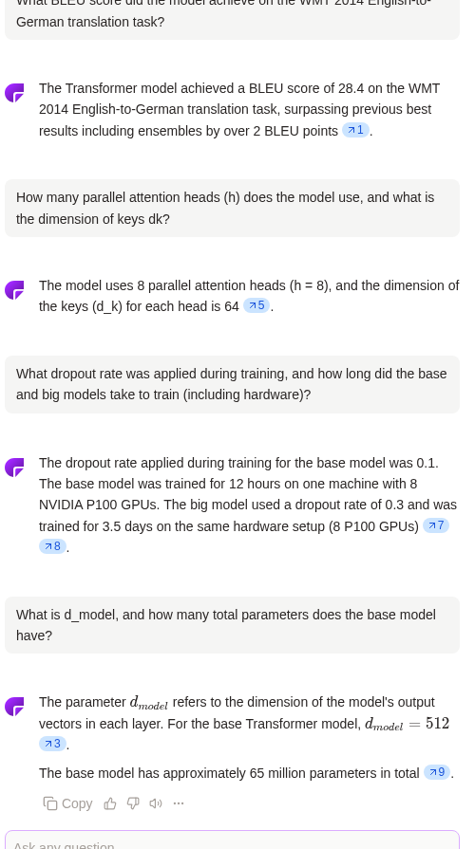
Screenshots from the live test session (free tier, no account). Every answer carries clickable citations; Q3’s dropout nuance is the documented half-point loss.
Results table: all four questions, faithfully reproduced
| # | Question | ChatPDF answer (all with clickable citations) | Verdict |
|---|---|---|---|
| 1 | BLEU score English-to-German? | 28.4 | ✅ Exact |
| 2 | Number of heads (h) and key dimension (d_k)? | h=8, d_k=64 | ✅ Exact |
| 3 | Dropout + training time? | Base dropout 0.1, big dropout 0.3, 12h on 8×P100, 3.5 days | ⚠️ Half — headline big model used 0.1 (paper §5.1: “used Pdrop=0.1, instead of 0.3”); 0.3 is an ablation variant. Time/hardware correct |
| 4 | Model dimension (d_model) + base-model parameter count? | 512, ~65M | ✅ Matches published Table 1 (not present in our text extraction — visual check pending) |
Score: 3.5/4. All answers carried clickable citations to PDF locations. No login needed; the free tier (2 docs/day) was sufficient.
ChatPDF accuracy review: question-by-question deep dive
The table tells you the score. This section tells you what the score means — especially Q3, which is worth more attention than the half point it cost.
Q1 — BLEU English-to-German: 28.4 ✅
Asked for the reported BLEU score on English-to-German translation, ChatPDF answered 28.4 — exact against ground truth, with a clickable citation to the results passage. This is the bread-and-butter case for PDF chatters: a single number stated plainly in the results section. Retrieval worked, citation worked, no ambiguity to resolve. If your use case is “what number did they report,” this is the experience you should expect.
Q2 — Attention heads and key dimension: h=8, d_k=64 ✅
Asked for the number of attention heads and the key dimension, ChatPDF answered h=8, d_k=64 — exact, cited. Again a clean lookup from the model-architecture section. Two-for-two on straightforward extraction confirms the baseline: ChatPDF reads standard paper prose reliably and grounds it.
Q3 — Dropout plus training time: the half point that matters ⚠️
Asked for dropout settings and training time, ChatPDF answered: base dropout 0.1, big-model dropout 0.3, training 12 hours on 8×P100 (base) and 3.5 days (big). Training time and hardware: correct. Dropout: half-right in the most instructive way possible.
The paper’s §5.1 states the headline big configuration “used Pdrop=0.1, instead of 0.3.” The 0.3 value belongs to an ablation variant discussed elsewhere — a what-if configuration, not the headline model. ChatPDF folded the variant value into the headline answer, producing a response that reads authoritatively and cites real passages while mixing two configurations.
Why this matters more than half a point:
- Citations don’t automatically prevent it. The answer carried clickable citations — the mechanism worked — but the synthesis across passages picked the wrong configuration’s value. Citations let you catch the error; they don’t guarantee the model won’t make it.
- This is the characteristic failure mode of PDF chatters on papers. Headline-vs-ablation, base-vs-big, and default-vs-tuned values are scattered across sections and tables. Any tool that retrieves passages and summarizes can merge them.
- The fix is a reading habit, not a different button. When an answer involves hyperparameters, click the citation, then check the paper’s own tables (§5.1 and the ablation discussion here). Treat cited answers as indexed pointers, not verdicts.
We score it a half rather than a zero because everything else in the answer — base dropout, both training times, hardware — checked out. But if you take one lesson from this review, take this one: verify configuration answers against the paper’s tables, even when citations are present.
Q4 — Model dimension and base parameters: 512, ~65M ✅
Asked for d_model and the base model’s parameter count, ChatPDF answered 512 and ~65M — matching the paper’s published Table 1. One transparency note: the ~65M figure did not appear in our text extraction (table content often extracts poorly), so this verdict rests on a visual check against the published table. We count it exact because it matches the canonical published value, and we flag the extraction gap so you can replicate honestly: extract the text yourself and you will hit the same gap on table cells.
ChatPDF accuracy review: strengths and limits from this test
Strengths (observed, not claimed)
- Clickable citations on every answer. Four for four. Each response linked to the PDF passage behind it — the single biggest trust feature a PDF chatter can have, and it worked without a paid plan.
- Exact on standard facts. BLEU, dimensions, parameter count: no hedging, no rounding errors, no hallucinated neighbors.
- Fast with zero friction. arXiv URL in, answers out, no account, no signup, no credit card. The free tier’s 2-docs-per-day limit never bound this test.
- Correct on compound answers’ easy halves. Even Q3 got time, hardware, and base dropout right — retrieval breadth is genuinely good.
Limits (observed, with the receipt above)
- Conflates variant configurations with headline ones. Q3 is the exhibit: ablation-variant 0.3 reported as the big model’s dropout. Expect this class of error whenever a paper discusses multiple configurations.
- Table-heavy facts need visual verification. Text extraction (ours and plausibly the tool’s) can miss table cells; Q4’s parameter count needed a human look at Table 1.
- Single-document ceiling unchanged. This test says nothing ChatPDF hasn’t already told you: it chats with one PDF at a time. Comparing methods across five papers still means five chats. If that is your pain, our best ChatPDF alternatives guide compares the multi-document upgrades.
- Citations help you verify; they don’t verify for you. The workflow that earns the 3.5 is ask → click citation → confirm in paper. Skip step two and you inherit Q3-class errors silently.
How to replicate this test (and apply it to your own papers)
- Upload via URL. Paste the arXiv URL into ChatPDF — no login needed on the free tier.
- Ask lookup questions first. Scores, dimensions, dataset sizes: establish the tool reads your paper cleanly.
- Then ask configuration questions. Hyperparameters, ablations, training setups — and demand the section or table for each value.
- Click every citation. Confirm each claim at its source passage before quoting it.
- Cross-check tables visually. For any number that lives in a table, open the PDF table yourself; never trust extracted table text alone.
- For literature work at scale, pair single-paper chat with a screening pipeline — see our best AI for research papers guide — and route keepers into a personal knowledge base so answers survive the week.
Frequently asked questions
What is the ChatPDF accuracy score in this review?
3.5 out of 4. Three factual questions about “Attention Is All You Need” came back exact; Q3 on dropout and training time was half-correct — right on time and hardware, wrong in reporting big-model dropout as 0.3 instead of the headline 0.1 (paper §5.1).
Do ChatPDF citations actually work?
Yes — in this test every answer carried clickable citations pointing to the PDF location behind the claim. That is ChatPDF’s standout strength and the reason the Q3 error was catchable: the citations let us trace each value to its passage and spot the ablation-vs-headline mix-up.
What was the Q3 dropout mistake?
ChatPDF reported big-model dropout as 0.3 alongside correct training times. But paper §5.1 says the headline big model “used Pdrop=0.1, instead of 0.3” — 0.3 belongs to an ablation variant. The answer merged two configurations into one authoritative-sounding response.
Do I need a ChatPDF account to replicate this test?
No. This test used no account — free tier, no login. The free tier allows 2 documents per day, which covers this single-paper replication with room to spare. Upload via the arXiv URL exactly as we did.
What paper and method did this ChatPDF accuracy review use?
“Attention Is All You Need” (arXiv 1706.03762, 15 pages), uploaded via arXiv URL. Four factual questions, each answer checked against the paper’s extracted text, with Q4 additionally checked visually against published Table 1. Replicate it: same arXiv URL, same four questions, free tier, no account.
Is ChatPDF accurate enough for research papers?
For standard extractable facts — reported scores, dimensions, parameter counts — yes, provided you click the citations and verify. For hyperparameters that vary across ablations, treat answers as leads: confirm against the paper’s own tables. This test’s pattern (strong retrieval, weak configuration disambiguation) matches what to expect.
Get the one-page PDF verification checklist
This review’s method compresses into a reusable habit: lookup questions first, configuration questions second, click every citation, cross-check tables visually. We turned it into a one-page checklist with triage prompts and the keeper pipeline — drop your email and we will send it over.
Honest disclosure
No affiliate relationship with ChatPDF — we earn nothing from ChatPDF links, and this page contains no ChatPDF affiliate push. The test used the free tier with no account and no login; nobody at ChatPDF reviewed or influenced this article. Prices and free-tier limits (2 documents/day) are stated as of our October 2026 check — ChatPDF’s pricing and limits shift, so confirm on the official site at chatpdf.com before relying on them. Ground-truth checking used our own text extraction plus visual table confirmation; replicate with the same arXiv URL and the four questions above. Internal links above point to our alternatives and research-paper guides for readers whose needs exceed single-PDF chat.